How to Choose the Right Binding Coil: A Complete Guide to Spiral, Double Wire, and Plastic Coils for Notebook Manufacturing
Selecting the correct binding coil is one of the most critical decisions in notebook manufacturing. The coil is not just a functional component that holds pages together — it directly impacts the user experience, product durability, aesthetic appeal, and ultimately, your brand reputation. Whether you are sourcing coils for office notebooks, children's books, luxury planners, or custom promotional products, understanding the differences between coil types, materials, and specifications will help you make informed decisions and avoid costly mistakes.
In this comprehensive guide, we cover everything you need to know about binding coils — from metal double wire and single wire coils to PET plastic spirals — along with key selection criteria, industry applications, and quality standards.
1. Types of Binding Coils
There are four main types of binding coils used in the notebook and stationery industry. Each type has distinct characteristics that make it suitable for different applications.
1.1 Metal Double Wire (Twin Loop) Binding
Double wire binding — also known as twin loop or Wire-O binding — consists of two parallel wire loops formed into a C-shape, which are inserted through punched holes and then closed to form a secure O-shape. This is the most popular binding style for premium notebooks, calendars, and presentation documents.
Key Advantages:
-Professional appearance: Clean, sleek finish ideal for corporate and premium products
-360-degree page rotation: Pages fold back completely flat, making it easy to write on both sides
-Excellent page alignment: Twin wire structure keeps pages perfectly aligned without shifting
-Wide size range: Available in diameters from 1/4" (6.4mm) to 1-1/4" (32mm), accommodating 20 to 300+ pages
-Color variety: Available in standard black, white, silver, gold, copper, and custom Pantone-matched colors
Common Applications: Executive notebooks, wall calendars, photo albums, corporate reports, luxury planners
1.2 Metal Single Wire (Spiral) Binding
Single wire spiral binding uses a continuous helix-shaped wire that is threaded through punched holes along the document edge. It offers greater flexibility than double wire and is often more cost-effective for larger production runs.
Key Advantages:
-Greater flexibility: The spiral shape allows pages to wrap around more freely
-Cost-effective: Generally more affordable than double wire for high-volume orders
-Durable hold: Continuous wire design provides strong, reliable page retention
-Versatile sizing: Available from 6mm to 50mm diameters
-Material options: Available in galvanized steel, stainless steel, and coated variants
Common Applications: School notebooks, training manuals, cookbooks, reference books, spiral calendars
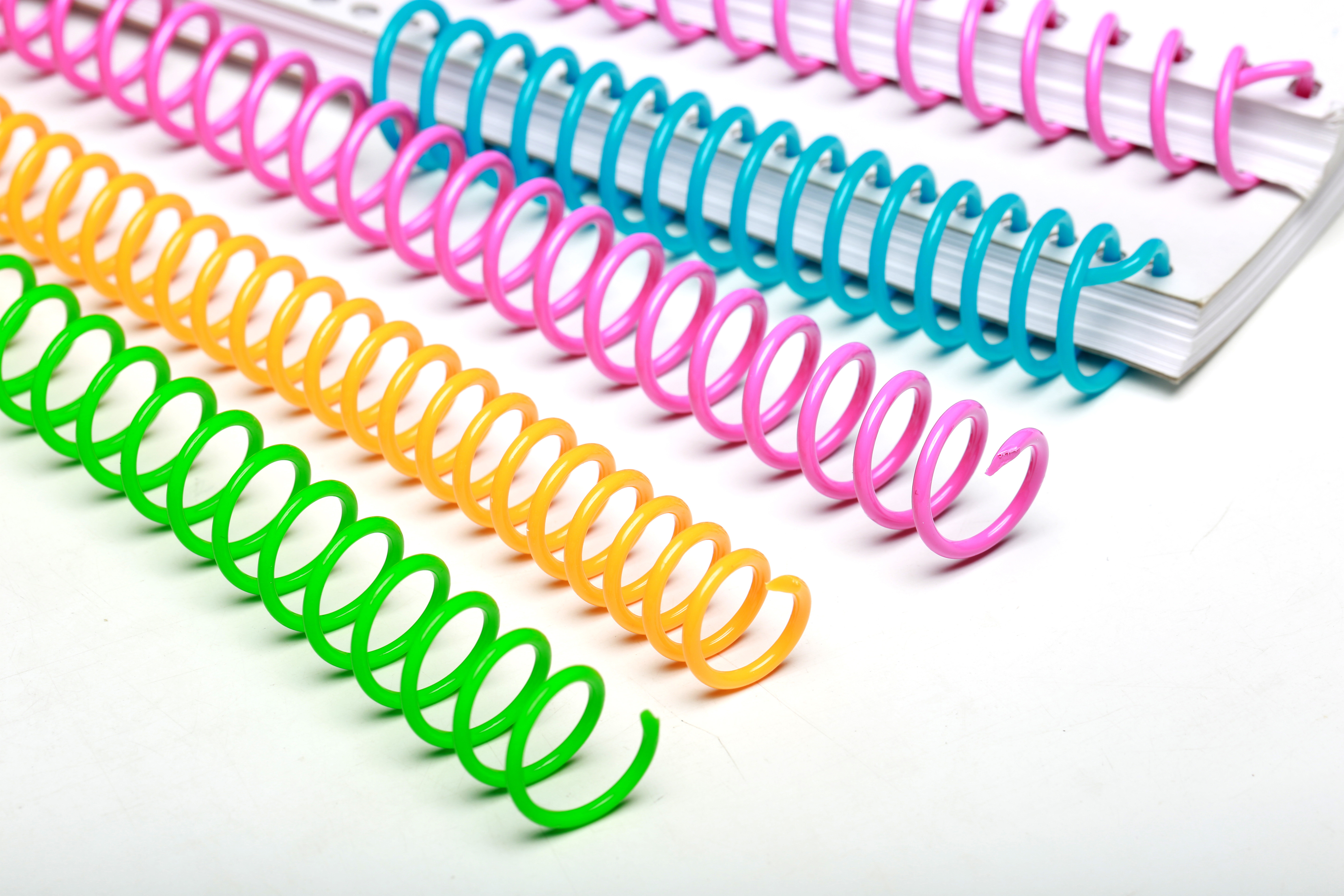
1.3 PET / Plastic Spiral Coil
Plastic spiral coils are made from PET (polyethylene terephthalate) or nylon materials. They are lightweight, corrosion-resistant, and available in an extensive range of vibrant colors — making them the preferred choice for children's products, lifestyle notebooks, and colorful creative projects.
Key Advantages:
-100% rust-proof and corrosion-resistant: Ideal for humid environments, outdoor use, and products that may contact water
-Lightweight: Significantly lighter than metal coils, reducing shipping costs for bulk orders
-Hypoallergenic and safe: Food-grade PET materials available, certified for children's products
-Extensive color range: Thousands of color options including transparent, fluorescent, metallic-effect, and custom Pantone matching
-Non-scratch: Soft plastic surface won't scratch desks, devices, or other items
-Eco-friendly options: Recyclable PET and bio-based alternatives available
Common Applications: Children's books, recipe books, fitness journals, travel notebooks, outdoor guides, school notebooks
Coil Type Comparison at a Glance
Feature | Double Wire | Single Wire | PET/PVC Plastic |
Durability | High | High | High |
Rust Resistance | Good | Good | 100% Rust-proof |
Cost | Medium | Medium | Low-Medium |
Color Options | Customize any color | Customize any color | Customize any color |
Weight | Light | Light | Light |
Best For | Training manuals | Children's books | Branded gifts |
2. Key Specifications to Understand
When ordering binding coils, you need to specify several technical parameters. Getting these wrong can result in loose pages, difficult page-turning, or coils that do not fit the punched holes.
2.1 Coil Diameter (Pitch Circle Diameter)
The coil diameter determines how many pages can be bound. It is measured in millimeters (mm) or inches. The general rule is that the coil diameter should be approximately 2-3mm larger than the total thickness of the pages to allow comfortable page-turning.
| Coil Diameter | Approx. Page Capacity | Typical Use |
6.4mm (1/4") | 20-30 pages | Thin brochures, booklets |
7.9mm (5/16") | 40-55 pages | Pocket notebooks |
9.5mm (3/8") | 55-70 pages | A5 notebooks, slim planners |
11.1mm (7/16") | 70-90 pages | Standard A5/A6 notebooks |
12.7mm (1/2") | 90-110 pages | Full-size notebooks |
| 14.3mm (9/16") | 110-130 pages | Thick notebooks, planners |
| 15.9mm (5/8") | 130-150 pages | Large journals |
| 19.0mm (3/4") | 150-200 pages | Wall calendars |
25.4mm (1") | 200-260 pages | Thick desktop calendars |
32mm (1-1/4") | 260-330 pages | Large wall calendars |
2.2 Pitch (Hole Spacing)
Pitch refers to the distance between consecutive loops or holes. The most common pitches are:
-3:1 pitch (3 holes per inch / 8.47mm): Tighter loop spacing, more loops per inch. Used for thinner documents and smaller note taking notebooks. Provides a cleaner, more refined look.
-2:1 pitch (2 holes per inch / 12.7mm): Wider loop spacing, fewer loops per inch. Standard for most notebooks, calendars, and thicker documents. More cost-effective for large production runs.
Choosing the wrong pitch means your punched holes will not align with the coil loops — a critical and expensive mistake to avoid.
2.3 Wire Gauge (Thickness)
Wire gauge affects the strength and rigidity of the coil. Common gauges for double wire binding range from 0.7mm to 1.2mm in wire diameter. Thicker gauges provide more durability but are harder to close and may require specialized equipment.
2.4 Loop Count
The total number of loops on a coil depends on the binding edge length and the pitch. For a standard A4 (297mm) binding edge at 3:1 pitch, you would need approximately 34 loops. At 2:1 pitch, approximately 23 loops. Always confirm the exact loop count with your supplier before ordering.
3. How to Match Coil Type to Your Notebook Application
Different notebook types have different requirements. Here is a practical guide to matching the right coil to your product:
3.1 Office & Corporate Notebooks
-Recommendation: Metal double wire, 3:1 pitch, black or silver finish
-Why: Professional appearance, durable for daily use, lies flat for writing
-Diameter: 9.5mm to 14.3mm depending on page count
3.2 Children's Books & Educational Materials
-Recommendation: PET plastic spiral, 2:1 pitch, bright colors
-Why: Rust-proof, safe for children, lightweight, visually appealing
-Diameter: 8mm to 12.7mm
-Note: Ensure coil materials pass EN71-3 or similar safety certifications
3.3 Recipe Books & Kitchen Notebooks
-Recommendation: PET plastic spiral or nylon-coated metal
-Why: Kitchen environments are humid; plastic coils won't rust. Pages need to stay open flat on the counter.
-Diameter: 11.1mm to 15.9mm
3.4 Wall Calendars & Desk Calendars
-Recommendation: Metal double wire, 2:1 pitch, with built-in hanging hook
-Why: Strong enough to support the weight of the calendar when hung; double wire provides clean page-turning
-Diameter: 14.3mm to 32mm (thicker for larger page counts)
-Note: Consider half-moon or D-ring hanger integration for wall calendars
3.5 Art Sketchbooks & Drawing Pads
-Recommendation: Metal single wire or double wire, large diameter
-Why: Heavy paper stock requires strong binding; pages must lay perfectly flat for drawing
-Diameter: 14.3mm to 25.4mm
3.6 Promotional & Event Notebooks
-Recommendation: PET plastic spiral or nylon-coated metal, custom color
-Why: Brand color matching available; cost-effective for large quantities
-Diameter: 8mm to 11.1mm for slim giveaway notebooks
4. Material Selection: Metal vs. Plastic
Choosing between metal and plastic coils involves weighing several factors:
Metal Coils (Steel, Galvanized Steel, Stainless Steel)
-Pros: Superior strength, premium feel, recyclable, excellent page retention, precise end-bending
-Cons: Heavier weight (higher shipping costs), potential rust risk if coating is damaged, more expensive, limited color options without coating
-Best for: Premium products, high-page-count documents, products requiring long-term durability
PET/PVC Plastic Coils
-Pros: 100% rust-proof, lightweight, extensive color range, non-scratch, food-grade safety available, lower cost
-Cons: Less rigid than metal, can deform under extreme pressure, may yellow over time with UV exposure (unless UV-stabilized)
-Best for: Children's products, kitchen/humidity-exposed items, colorful creative products, budget-conscious projects
5. Quality Standards to Check Before Ordering
When evaluating a coil supplier, look for these quality indicators:
5.1 End-Bending Quality
For double wire coils, the ends must be precisely bent and crimped to prevent the wire from catching on clothing or scratching the user. Poorly finished ends are a common quality complaint. YPS uses automated CNC end-bending equipment to ensure consistent, smooth, burr-free finishes on every coil.
5.2 Coating Uniformity
For coated metal coils, check that the coating is evenly applied without thin spots, bubbles, or peeling. A quality coating should withstand at least 48 hours of salt spray testing without rust appearing.
5.3 Diameter Consistency
Coil diameter should be consistent across the entire length. Variations of more than ±0.2mm can cause uneven binding tension and poor page alignment.
5.4 Spring-Back Resistance
A quality coil should hold its shape after binding. Perform a spring-back test: bind a sample notebook, open it to the middle, and verify that the coil does not permanently deform.
5.5 Burr-Free Cutting
All cut ends should be clean, smooth, and free of sharp burrs. This is especially important for metal coils used in children's products.
6. Why Choose YPS as Your Binding Coil Partner
At YPS Binding Technology, we manufacture binding coils in-house as part of our vertically integrated production model. This means:
-Direct factory pricing: No middlemen — you get competitive pricing on coils of any specification
-Full customization: Diameter, pitch, color, material, and packaging — all tailored to your exact requirements
-Quality control at every stage: From raw material inspection to finished product testing, every coil passes through our ISO9001-certified quality system
-End-to-end service: We don't just supply coils — we also manufacture notebooks, so we understand how coil performance affects the final product
-Fast sampling: 3-7 day sample turnaround for custom coil specifications
-Flexible MOQ: Whether you need 1,000 coils for a trial run or 500,000 for a major order, we can accommodate
-Global shipping: Reliable logistics to North America, Europe, Southeast Asia, and beyond
7. Frequently Asked Questions
Q: How do I calculate the correct coil diameter for my notebook?
Measure the total thickness of your bound pages (including covers) with a caliper, then add 2-3mm for comfortable page-turning. For example, if your page stack is 8mm thick, order a 10-11mm diameter coil.
Q: Can I get custom coil colors to match my brand?
Yes. For PET plastic coils, we can match any Pantone color. For metal coils, we offer nylon coating in custom colors with a minimum order quantity.
Q: What is the difference between 3:1 and 2:1 pitch?
3:1 pitch has 3 holes per inch (tighter spacing), giving a cleaner look and better page control for thin to medium documents. 2:1 pitch has 2 holes per inch (wider spacing), which is standard for thicker notebooks and calendars. The choice depends on your page count and aesthetic preference.
Q: Are your plastic coils eco-friendly?
Yes. Our standard PET coils are recyclable, and we also offer R-PET (recycled PET) coils made from post-consumer plastic bottles. Contact us for R-PET specifications and pricing.
Q: Do you provide coil samples before bulk ordering?
Absolutely. We provide free coil samples in standard sizes and colors so you can test fit and quality before committing to a full production run. Custom color samples are also available with a small setup fee.
Conclusion
Choosing the right binding coil is a decision that affects your product's functionality, appearance, durability, and cost. By understanding the differences between coil types, getting the specifications right, and working with a reliable manufacturer, you can ensure your notebooks deliver an exceptional user experience every time.
If you already have a notebook project and need guidance on coil selection, the YPS binding technology team is always available to assist you. Please contact us via email or visit our website to obtain quotations or samples.